What Nobody Tells You About Measuring AI. From Someone Who's Been In The Room

Updated: Jul 7
Personal Brand Blog - Aisha Ariel Davis
The framework is one thing. The reality of what happens inside organizations is another. Here's what I've actually seen.
Aisha Ariel Davis
AI Workforce Transformation Subject Matter Expert
June 2026
I published a LinkedIn article this week on what organizations should actually be measuring when it comes to AI. The framework. The KPIs. The decision model for evaluating use cases.
But frameworks only tell part of the story.
The part I didn't put in the article — the part I want to share here — is what it actually looks like inside organizations that are trying to figure this out. Because the gap between knowing what to measure and actually building a system that measures it is where most transformations quietly fall apart.
So let me be real with you.
The Pattern I Keep Seeing
Across the organizations I've worked with, a few patterns show up again and again. The names and industries are different. The challenges are remarkably the same.
They measure what's easy, not what matters.
Time saved. Prompts submitted. Pilots completed. These feel like progress. They show well in a slide deck. But when budget gets tight, they don't survive — because they were never tied to a number the CFO cares about.
Someone in the middle is carrying the whole thing.
There's usually one person — sometimes in IT, sometimes in operations — who is passionate about AI and is trying to drive adoption without real executive sponsorship above them. They're doing heroic work. But without a leader at the top modeling the behavio#86C6E5r and publicly backing the initiative, it doesn't scale.
The POC becomes the finish line.
Organizations run a proof of concept, it goes well, and then... nothing happens. Because nobody defined what "going well" actually meant in business terms. The POC wasn't designed to prove a business KPI. It was designed to prove the technology works. Those are two completely different things.
AI is treated as a project, not a portfolio.
There's a start date, an end date, a budget. When the budget runs out, so does the momentum. The organizations that sustain AI transformation think about it as a living portfolio — with a roadmap, a governance model, and a reinvestment strategy built in from day one.
The Governance Problem — And a Biblical Parallel
This might sound unexpected, but stay with me.
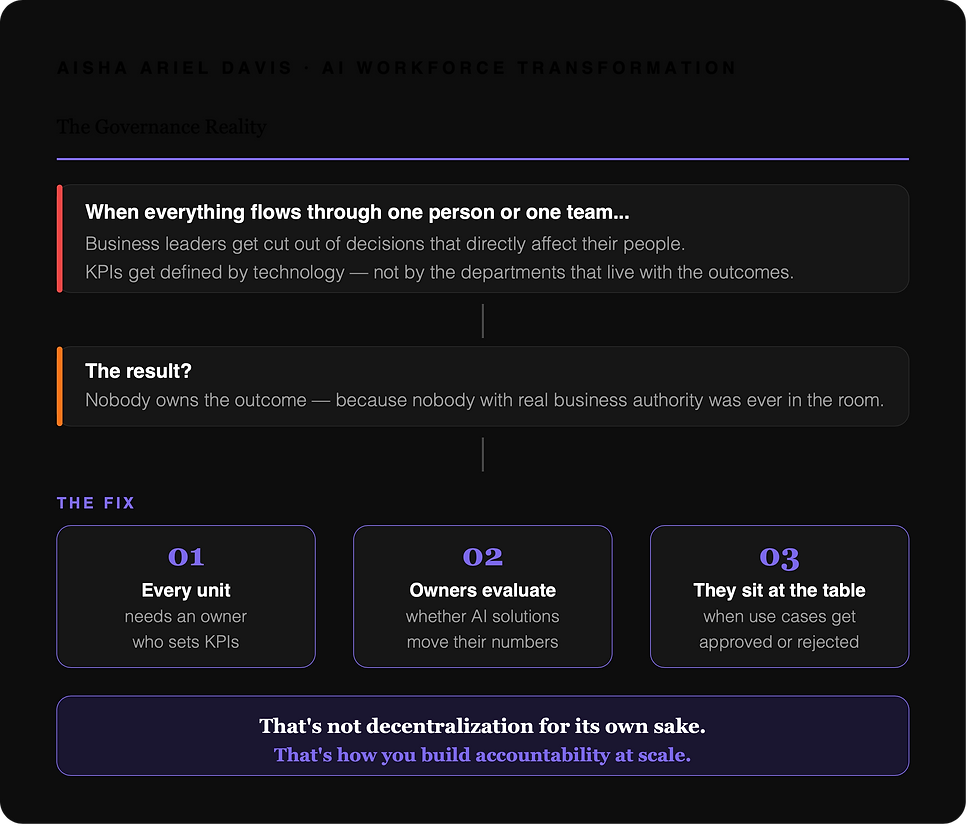
There's a story in the Bible where Moses is trying to lead and judge every decision for an entire nation by himself. His father-in-law Jethro watches this for a while and then pulls him aside: this is not sustainable. You cannot be the single point of decision for everything. You need leaders of thousands, leaders of hundreds, leaders of fifties, leaders of tens.
I think about this every time I see an organization where one centralized person — usually in IT — is the gatekeeper for every single AI use case, every agent, every initiative across the entire enterprise.
What "Executive Sponsorship" Actually Means
I want to be specific about this because I hear the phrase thrown around constantly and it almost always means something too small.
Executive sponsorship is not a leader who says "yes, we support AI" in a town hall and then goes back to reviewing quarterly numbers. That's lip service.
Real executive sponsorship looks like:
The leader uses AI themselves — in meetings, in decision-making, in their own daily work. Visibly. Not just asking their teams to adopt what they haven't touched.
The leader reviews AI KPIs — at the same cadence they review financial performance. If AI outcomes aren't in the executive review, they aren't a priority.
The leader champions responsible innovation — not just excitement about what AI can do, but clarity about how the organization will use it ethically, consistently, and with good judgment.
Without that person in place, everything else I've described — the KPIs, the governance model, the portfolio approach — is built on a foundation that can be pulled out from under it at any time.
"AI cannot be treated as a project. It has to be managed as a portfolio — with a roadmap, a reinvestment strategy, and executive visibility built in from day one."
Where to Actually Start
If you're reading this and feeling like your organization is somewhere in the middle of this — you have some AI initiatives running, you're not sure what you're measuring, you don't have full executive sponsorship — here's the honest answer:
Start with the KPIs, not the tools. Before the next pilot gets approved, define what business outcome it's supposed to move. Make that the condition of investment.
Find your executive sponsor — or build the case for one. If you're the person in the middle carrying this, your job isn't just to drive adoption. It's to make the business case visible enough that a leader above you feels the urgency to get involved.
Treat every use case as an investment decision. Not every AI idea deserves to be built. The ones that get funded should be the ones with clear KPI alignment, defined feasibility, and a business owner who is accountable for the outcome.
This is the work that happens before the technology. And in my experience, it's the work most organizations skip — because it's harder and slower than just deploying a tool.
But it's the only work that actually lasts.
I'll keep sharing what I see in the field — patterns, frameworks, and the honest reality of what AI transformation looks like from the inside.
If any of this resonated, follow along. There's a lot more where this came from.
This post is the companion piece to my LinkedIn article: "You're Measuring AI Wrong — Here's What Actually Counts." The article covers the framework. This is the reality behind it.
Aisha Ariel Davis
AI Workforce Transformation Subject Matter Expert with nearly two decades partnered with Microsoft — beginning as a DigiGirl in 2008 through Senior AI Solutions Specialist today. Published author of six books. I share what it actually takes to transform an organization with AI. No hype. Just what works.


Comments